

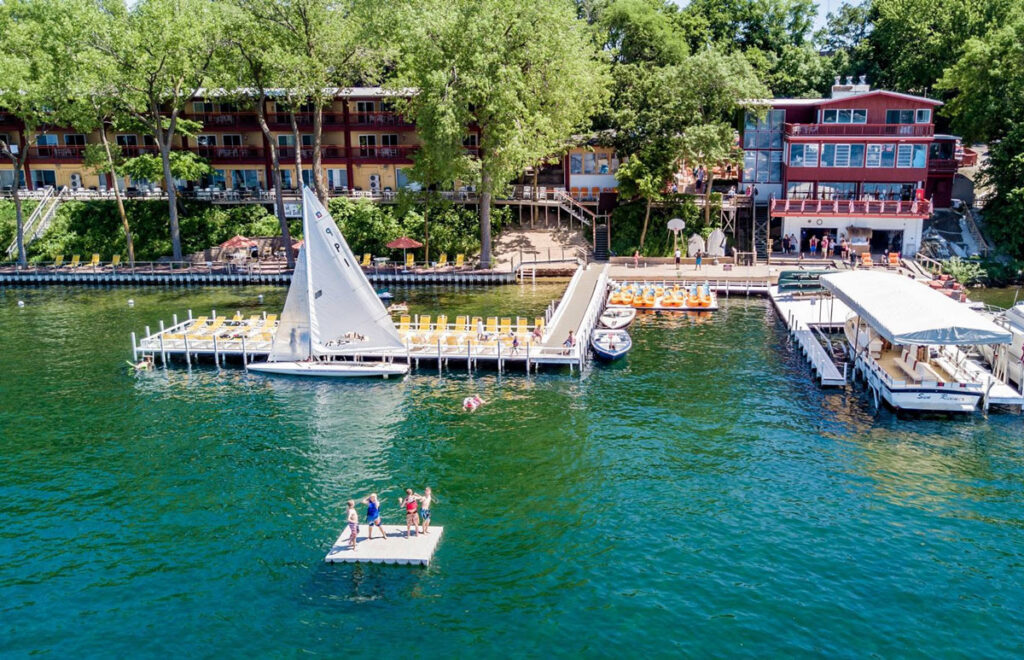
West Lake Okoboji averages 56°F in May, 70°F in June, 77°F in July, 76°F in August and 70°F in September, measured across twelve years of daily readings at Iowa Lakeside Laboratory. The monthly average is the wrong number to plan around, though. June and September share that same 70°F and are nothing alike: in the last ten days of June the water reaches 70°F on 92% of days, and in the first ten days it manages that on 23%. The first ten days of September average 73°F, which is warmer than the middle of June. Guests ask us about this every year, usually in about February. The answer is that you book a week, not a month.
Key Takeaways
- July is warmest at 77°F. August is a degree behind and far more predictable.
- The swimming window runs from about June 21 to about September 10, not June to September.
- The first ten days of September are warmer than mid-June, and almost nobody knows it.
- May averages 56°F. Clear water is not warm water.
- The sensor behind these numbers was retired in 2023. The live reading now comes from the Lakeside Lab buoy.
Water temperature by month
Every daily reading taken at the Lakeside Lab gauge between 2011 and 2023, averaged by month and converted to Fahrenheit. The right-hand column is the gap between the coldest and warmest version of that month across those years.
| Month | Average | Range across years |
|---|---|---|
| May | 56°F | 53°F to 62°F |
| June | 70°F | 66°F to 74°F |
| July | 77°F | 73°F to 80°F |
| August | 76°F | 74°F to 77°F |
| September | 70°F | 67°F to 72°F |
Two things there are worth stopping on. May to June is a 14 degree jump, the largest move in the calendar by some distance. And August barely varies. Three degrees separate the coolest August on record from the warmest, which makes it the safest week to book if you want the least argument with the weather.
Why the month is the wrong unit
Here is the same twelve years cut into ten-day blocks. The percentage is how often the water hit 70°F or better, which is roughly the point at which children stop announcing that it is cold.
- June 1 to 10: 67°F, at 70°F or better on 23% of days
- June 11 to 20: 71°F, on 56% of days
- June 21 to 30: 73°F, on 92% of days
- September 1 to 10: 73°F, on 86% of days
- September 11 to 20: 70°F, on 45% of days
- September 21 to 30: 67°F, on 9% of days
Read the first three lines again. The difference between the start of June and the end of it is the difference between a week of paddle boats and a week of swimming.
The September numbers are the ones that surprise people, and they surprise guests who have been coming here for forty years. All the depth that makes this lake slow to warm makes it slow to give the heat back. Then it stops: the last ten days of September get to 70°F on fewer than one day in ten, and the fall from September to October is 13 degrees. We close September 19, which sits just about exactly on that edge, and that is not a coincidence.
So here is an opinion, since we are the ones with the dock. The first week of September is the best week on this lake. Warm water, empty lake, and it falls inside our discounted season. We will also tell you the catch, because you would rather hear it now: the reduced-rate periods do not carry the full programme. Water skiing, sailing, the History Cruise and the Million Dollar Home Cruise are not normally running then. You are trading the activity schedule for the water and the quiet. Plenty of people make that trade on purpose.
Why this lake warms up so slowly
Because there is a great deal of water in it and most of it is deep. West Lake covers about 3,847 acres and runs to roughly 136 feet, the deepest natural lake in Iowa, cut by the Wisconsin glacier around 14,000 years ago and fed by springs rather than runoff. The Iowa DNR lists it as an Outstanding Iowa Water. All of which is excellent for clarity and unhelpful in May.
That clarity is the thing people misread. Stand on the Main Beach Dock in the middle of May and you can see the bottom, because the algae has not started yet and the lake is at its clearest of the year. It looks like bath water. It is 56 degrees.
By early summer the lake sorts itself into layers, warm on top, cold underneath, with a narrow band called the thermocline between them. That band is sharp enough to feel. Hang your legs off a paddle boat in July and the water at your ankles can be a good deal colder than the water at your knees.
Wind moves the surface number faster than sunshine does. A few days of it pushes the warm layer to one end of the lake and drags colder water up behind it. The record has this in it plainly: in September 2020 the lake read 73°F on the 6th and 64°F on the 9th. Nine degrees, three days. That is the usual reason a family arrives expecting one thing and finds another, and it is why we would rather you looked at the wind forecast than the calendar.
Where these numbers come from
USGS gauge 06604200 at Iowa Lakeside Laboratory, which recorded daily water temperature from October 2011. That sensor was discontinued in November 2023. The gauge is still there and still the place to check lake level. It has not reported a temperature in over two years, which is worth knowing, because plenty of pages still send people there for one.
For today’s reading, use the research buoy run by Iowa Lakeside Laboratory, which has been studying this water since 1909. It sits in 98 feet off the north end of Sunset Beach, not far off our own shoreline, and reports every ten minutes. The public feed is free and there is an app if you want it on the drive up.
If a site gives you a precise current temperature and it is not the buoy, it is almost certainly modelled from air temperature and satellite data rather than measured. That is not worthless. It just smooths over the wind, the bays and the thermocline, which are the three things that decide your week.
Swimming with kids, and which shoreline
Late June through the first week of September, the water is fine for children on most days. Before that, plan on the pool and enjoy the boats.
Children lose heat faster than adults and will keep playing long past the point of being cold, so watch for it rather than waiting to be told. Spring and autumn are when the gap between air and water is widest, and that gap is what catches people out. An 80 degree afternoon over 58 degree water is not a swimming day, whatever it looks like from the deck.
Where matters as much as when. Our Main Beach has a protected swimming area, a swim platform and 20 feet of man-made sand, which is exactly as much sand as it sounds like and enough for what it does. South Beach adjoins one of the best natural sand beaches in the area and is the one to ask for if the children are small. North Beach is rocky, because the glacier left it that way, so bring water shoes. Shallow sheltered water runs warmer than the buoy says; open water off a point runs cooler. None of our beaches are lifeguarded and children need an adult in the water with them.
At a public beach rather than ours, the Iowa DNR samples Emerson Bay, Gull Point, Pikes Point and Triboji weekly between Memorial Day and Labor Day, posting on Fridays. Check the DNR beach monitoring map first. A warm, still, late-August week is exactly what produces an advisory, so warm and safe are not the same question.
What a cold week actually looks like here
You swim in Old Faithful. A.T. Fillenwarth built it in 1918, the first cottage on this shoreline. In 1968 it was one of only two buildings left standing when the tornado took the main beach. In the 1970s it became the indoor pool, which is heated, as is the outdoor pool at Cottage Colony. That is the honest answer to a cold week. It is also most of the argument for a resort over a rental house in May or September. In a rental house, a cold snap is just a cold snap.
The rest of it carries on regardless. The Sun Runner cruises run 45 minutes in the afternoon whatever the water is doing. The paddle boats, canoes and rowboats sit on the dock with no sign-up sheet, which is why they are the answer to early June. And the Seawalk faces west, so the lounges get the full evening light off the lake on a day nobody swam. See the complimentary activities for what runs when.
FAQ
How cold is West Lake Okoboji in June?
It depends which June you mean. The first ten days average 67°F and reach 70°F on under a quarter of days. The last ten average 73°F and reach it on more than nine days in ten. If the trip is about swimming, book the end of the month.
What is the warmest month at Lake Okoboji?
July, at 77°F, usually peaking in the last week. August runs 76°F and varies only about three degrees year to year, so it is the better bet if you want predictability over the top temperature.
Can you swim in West Lake Okoboji in September?
Early September, comfortably. The first ten days average 73°F and hit 70°F or better on 86% of days, warmer than mid-June. After the 20th it cools off quickly and reaches 70°F on fewer than one day in ten.
Why does the water drop after a windy few days?
Wind pushes the warm surface layer to one end of the lake and pulls colder water up to replace it. Normal on a deep lake, and not subtle. In September 2020 the surface went from 73°F to 64°F in three days.
If you are choosing between weeks and the water is the deciding factor, call us. Someone who has watched this lake come up to temperature a good many times will answer, and we would rather talk you into the right week than the nearest one with a vacancy. (712) 332-5646, or the reservations page.